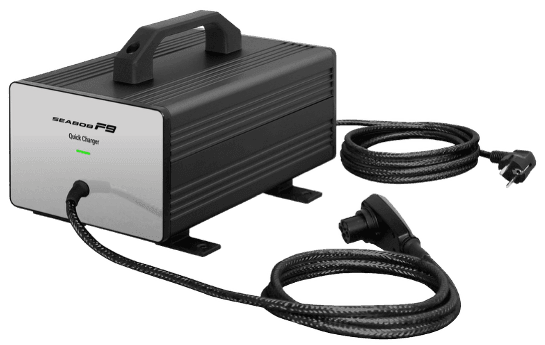
Most Seabob problems come down to two things done wrong: charging with the wrong or a dirty charger, and leaving the battery flat in storage. Get those two right and a Seabob is a remarkably reliable machine — the manual's care rules are short, and they work.
These rules come straight from the official operator's manual. Nothing here is invented: charge only with a CAYAGO charger made for your exact model, always through a clean, dry port, and never let a pack sit below 50% charge in storage.
For anything beyond routine care — a tired battery, a locked pack, a reseal or a repair — our battery service and workshop are the same team that runs the rental fleet. Message us on WhatsApp if you're not sure whether your unit needs attention.
- Chargers
- CAYAGO charger for your model only
- Cable
- Rated at least 10 A
- Storage charge
- At least 50%, never below
- Recharge in storage
- At least every 4 weeks
- Optimum storage temp
- +10 to +25 °C
Rinse after every use
Salt is the enemy, and it starts working the moment the unit dries. Rinse the Seabob with low-pressure fresh water after every session — a hose or a watering can is fine. Pay attention to the water inlet and outlet, where salt and sand collect.
- Use low-pressure fresh water only — never a high-pressure washer, which forces salt into the seals.
- Rinse the water inlet and outlet and the jet channel.
- Wipe down with a soft cloth; a mild, plastic-safe cleaner only, nothing abrasive or solvent-based.
- Before cleaning, put the unit into Deep Sleep or Cargo mode so it can't switch on mid-clean.
Charging done right
The manual is specific here, and for good reason: a battery pack is the most expensive single part of the machine. Charge only with a CAYAGO charger built for your specific model, on a cable rated at least 10 A, in a dry, cool, shaded, well-ventilated place.
| Model | Operating time | Standard charge | Quick charge |
|---|---|---|---|
| Seabob F9 | up to 40 min (60 min with Battery Capacity Plus) | approx. 4 h (6 h Plus) | approx. 1 h (1.5 h Plus) |
| Seabob F9 S | up to 50 min | approx. 6 h | approx. 1.5 h |
| Seabob F5 | approx. 50 min | approx. 8 h | approx. 1.5 h |
| Seabob F5 S | approx. 60 min | approx. 7 h | approx. 1.5 h |
| Seabob F5 SR | approx. 60 min | approx. 7 h | approx. 1.5 h |
The Quick Charger is a separate purchase for the F9 family — roughly an hour instead of four. It's a convenience, not a license to skip the rest of the rules: the port and connector still have to be clean and dry, and the unit still charges in a cool, ventilated place.
F5 owners: charge within 24 hours
The F5 quick reference is stricter about timing: charge after every use, within 24 hours. In storage the F5 sits on a trickle charge, and its Off mode should never exceed 4 weeks — beyond that the pack self-discharges too far.
Battery care
A Seabob battery is a lithium pack with a finite number of cycles, and how long it lasts is almost entirely down to how it's charged and stored. The good news is that the rules are few and cheap to follow.
- Never store a flat pack. Keep it at at least 50% charge between uses.
- Recharge at least every 4 weeks in storage — a lithium pack self-discharges, and a pack that drops too low can lock and need a specialist reset.
- Avoid heat. Never leave the unit above 60 °C — in direct sun or a closed car the temperature climbs fast, and heat is what ages a battery.
- Use the Charging Limit setting (F9): capping the charge below 100% slows ageing when you don't need full range.
- If a pack has already locked after deep discharge, our battery service can reset the BMS and, when needed, re-cell with A-grade high-drain cells.
Storage and winter (kışlama)
A Seabob that's laid up for the winter needs four things, in order: the right mode, enough charge, a top-up schedule, and a cool, frost-free spot.
- 1Put it in Deep Sleep mode — this is the storage and transport state, and it draws almost nothing.
- 2Charge to at least 50% before you lay it up.
- 3Recharge at least every 4 weeks through the winter.
- 4Store cool, dry and frost-free — optimum is +10 to +25 °C.
- 5Never above 60 °C — keep it out of direct sun and out of a closed car.
Transport and air travel
Lithium batteries travel under strict rules, and the Seabob's own manual adds one: for air or long-distance transport, the F9 must be at a partial charge only — a maximum of 30%.
- Air transport: partial charge only (F9 max 30%) — never full, never flat.
- Use Deep Sleep mode for transport, the same state as storage.
- The F9 ships with a charger that also handles the air-transport and storage charge levels.
- Before any flight, confirm the airline and cargo rules for a lithium pack — requirements change and the paperwork is yours to have ready.
Wear parts to watch
The manual lists four items as genuine wear parts, and they're exactly the four that matter when you buy used or service a unit:
- Batteries — the single largest cost after the hull; cycles, heat and deep discharge decide their life.
- Seals — they keep water out; they age and they're checked at every service.
- Impeller — the moving part that pushes water; it wears and, occasionally, meets debris.
- Stator — the fixed ring around the impeller, which wears with it.
Everything above is a part we replace as routine. A tired or locked battery goes to battery service for re-celling; seals, impeller and stator, and anything cosmetic, go to the workshop. If a unit has been sitting, message us on WhatsApp and we'll tell you what to check before you plug it in.